The Inside-Out Cybersecurity Framework

Invert the stack.
Secure the core.

Written for decision-makers accountable for keeping mission systems running under assumed compromise, as frontier AI shrinks the time between a discovered flaw and a working exploit. GreyLee’s Inside-Out Cybersecurity Framework is the architecture behind Secure Enterprise Modernization. It starts with the mission-critical workload, makes containment the first control, and builds data protection, identity, intelligence and exposure management outward from that core.

The Premise

The threat moves in minutes. The mandate is set.

29 min

Average breakout time, 2025. Once inside a network, adversaries now begin moving laterally in an average of 29 minutes, and in as little as 27 seconds. Operations by AI-enabled adversaries rose 89 percent in a year. Frontier AI now finds and exploits flaws faster than vendors can publish fixes. An architecture that must detect or patch before it can contain is already behind.

FY2027

DoW Target Level zero trust. Executive Order 14028 set the direction. The DoW Zero Trust Strategy defines seven pillars and 152 activities, with Target Level due by the end of FY2027. Executive Order 14412 (June 2026) adds post-quantum migration deadlines of 2030 and 2031. The question is no longer whether to adopt zero trust, but where to start.

Threat figures: CrowdStrike 2026 Global Threat Report, February 2026; breakout time measured across eCrime intrusions. Frontier AI: Canadian Centre for Cyber Security, Frontier Artificial Intelligence (ITSAP.10.050), May 2026; Executive Order, Promoting Advanced Artificial Intelligence Innovation and Security, June 2026.

The Inversion

Start at the workload.

Defense in depth builds from the perimeter inward and reaches the mission last. Secure Enterprise Modernization is not a product. It is an architecture framework that keeps the same capabilities and reverses their priority, so containment is in place before detection is needed.
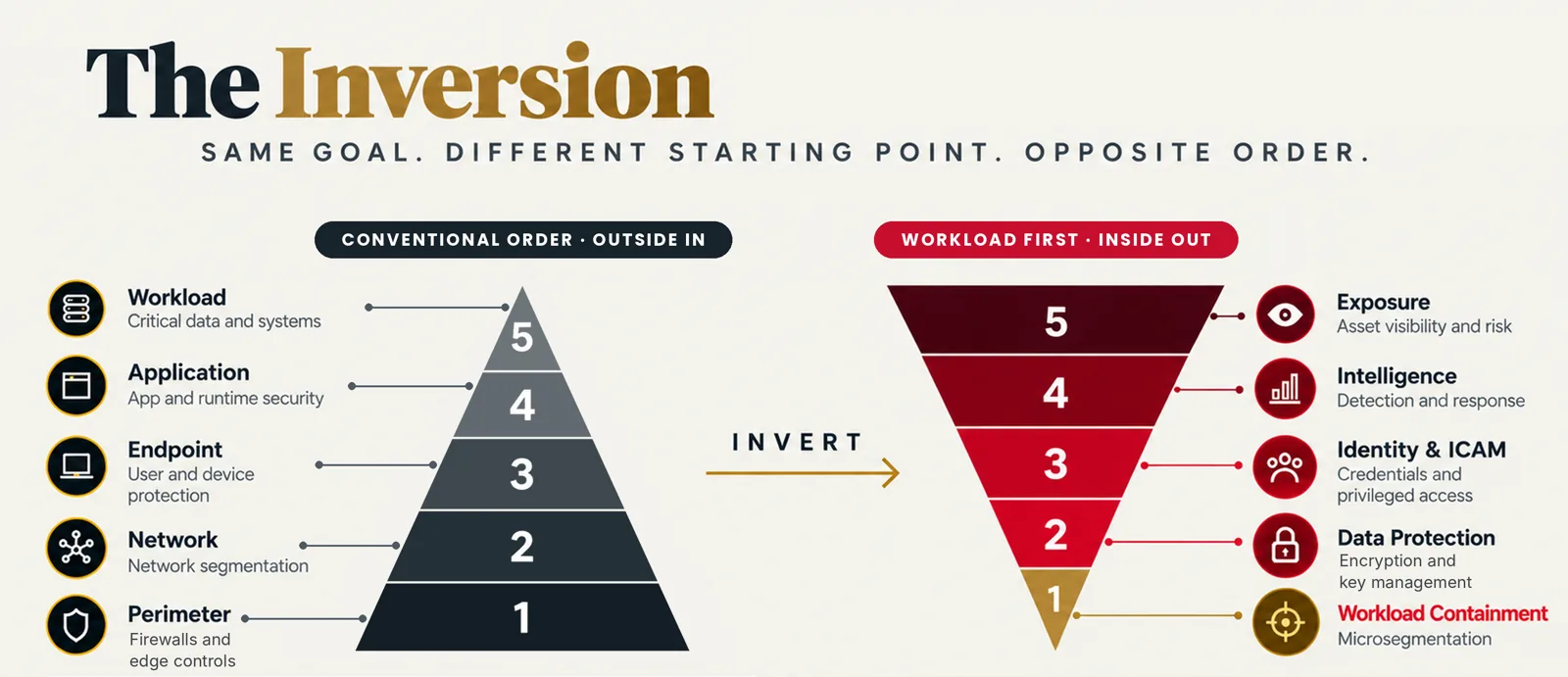
The Inversion — conventional order, outside in: perimeter, network, endpoint, application, workload. Workload first, inside out: workload containment, data protection, identity and ICAM, intelligence, exposure.

Numbers show protection priority, not installation order. Discovery and dependency mapping come first in practice, so containment never disrupts the mission.

The Missing Control

Zero trust programs govern access.
Few govern movement.

Every identity can be verified at the door, and one compromised workload can still reach the rest of the network. Zero trust is the strategy; microsegmentation is how it is enforced inside the network. It restricts every workload to the connections the mission actually requires, so an intrusion that gets past identity, device and perimeter controls stays where it started.

CISA · July 2025

“A critical component of ZTA”

Microsegmentation shrinks the attack surface, limits lateral movement after a breach and improves visibility into protected resources.

NSA · March 2024

Contain the intrusion

Data-flow mapping and microsegmentation are named capabilities for containing intrusions and restricting adversary lateral movement.

NIST SP 800-207

No trust by location

Being inside the network confers no trust. Each resource is protected on its own, not by the boundary around it.

01
Identity is not containment
MFA, ICAM and conditional access decide who gets in. They do not decide which workloads can reach each other once someone is in.
02
Network segmentation is not microsegmentation
VLANs and firewall zones separate networks, but broad rules inside each zone still let workloads reach far more than the mission requires.
03
Containment is scheduled last
Segmentation is often planned after identity, endpoint and network investments, even though it reduces risk soonest.
04
Progress is counted in products, not paths
A zero trust dashboard can show strong progress while critical workloads remain reachable through connections nothing requires.
Policy on the workload, not the address

Rules written on IP addresses and ports break as infrastructure changes and say nothing about what a workload is. Mature microsegmentation writes policy on what each workload does and where it runs, so containment holds across data center, cloud and OT.

What containment does not do

Microsegmentation narrows the paths an adversary can use; it does not make the permitted ones safe. That is why it is the first layer, not the only one. Data protection, identity and intelligence secure the connections that remain.

Sources: CISA, Microsegmentation in Zero Trust, Part One: Introduction and Planning, July 2025; NSA, Advancing Zero Trust Maturity Throughout the Network and Environment Pillar, March 2024; NIST SP 800-207, Zero Trust Architecture, August 2020.
The Architecture

Five layers, built from the workload outward.

Each answers one question about the protected mission.

1
Workload Containment Anchor layer
Microsegmentation · Dependency mapping · East-west visibility
Microsegmentation, dependency mapping and east-west control across IT, OT and AI workloads. Closes the lateral paths that turn one compromised workload into an enterprise event.
“Once an adversary is in, where can they go?”
2
Data Protection
Encryption & KMS · DSPM · DLP · PQC
Encryption, key management and sensitive-data discovery at the source, with a path to post-quantum cryptography.
“What does this workload hold, and is it protected?”
3
Identity & ICAM
IGA · PAM · MFA
Credentials, privileged access and identity governance for people, services and AI agents, built on the identity platform already in place.
“Who and what can reach this workload, and with which privileges?”
4
Intelligence
SIEM · SOAR · XDR
Detection, analytics and automated response across network, endpoint and identity signals.
“What is actually happening right now?”
5
Exposure
Asset inventory · Vulnerability management · OT & IoT
IT, OT and IoT asset visibility and vulnerability prioritization around the workload.
“Of everything around the workload, what gets fixed first?”
Layers 1–3. Microsegmentation, data protection and ICAM each have dedicated NSA zero trust guidance: Network & Environment (March 2024), Data (April 2024) and User (March 2023). In this architecture they are the first three layers, in that order.

KMS: key management; DSPM: data security posture management; DLP: data loss prevention; PQC: post-quantum cryptography; IGA: identity governance and administration; PAM: privileged access management; SIEM: security information and event management; SOAR: security orchestration, automation and response; XDR: extended detection and response. AI agents: CISA, NSA and Five Eyes partners, Careful Adoption of Agentic AI Services, May 2026.

Why Containment Is the Anchor

Four tests for any containment platform

NSA zero trust guidance (March 2024) lists microsegmentation as a key capability for limiting lateral movement. The architecture anchors on workload containment and holds any platform for it to four tests.

Visibility before enforcement

Map application dependencies and east-west traffic first, then model policy before anything is blocked, so containment never disrupts the mission.

Policy that follows the workload

Rules written on what a workload is and does, not on IP addresses, so protection holds as systems move across data center, cloud and OT.

Enforcement without re-architecture

Containment applied at the workload rather than through network redesign, so it can be deployed in weeks on systems already in service.

Built for federal missions

Federal authorization, on-premises and disconnected deployment for restricted environments, and open integration with the intelligence and response layers.

Federal Alignment

Five layers cover all seven DoW Zero Trust pillars.

Workload containment, the anchor, is primary in two and contributes telemetry to three more. Also aligned with NIST SP 800-207 and the CISA Zero Trust Maturity Model v2.0.

DoW Zero Trust pillar Primary layer Informed by containment
1 · User3 · Identity & ICAM—
2 · Device5 · Exposure—
3 · Applications & Workloads1 · Workload Containment—
4 · Data2 · Data ProtectionTraffic visibility and policy data from layer 1
5 · Network & Environment1 · Workload Containment—
6 · Automation & Orchestration4 · IntelligenceTraffic visibility and policy data from layer 1
7 · Visibility & Analytics4 · IntelligenceTraffic visibility and policy data from layer 1

Governance carries no manufacturer by design; it is delivered as architecture, control evidence and program leadership.

How It Works

One compromised workload.
Contained before it is even detected.

The architecture is technology-agnostic. Workload containment is the fixed starting point; every layer is filled by the capability that best fits the mission, including tools already in service.

1 · Containment
Contained

Segmentation policy is already in force. The intrusion cannot move laterally, even before anyone sees it.

2 · Data Protection
Protected

Data is encrypted at the source. What the adversary can reach, they cannot read.

3 · Identity & ICAM
Restricted

No standing privilege to steal. Credentials cannot be used to escalate.

4 · Intelligence
Detected

Signals are correlated and the threat confirmed, with containment already buying time.

5 · Exposure
Closed

The entry path and anything else exposed are found and fixed.

Logical architecture. Integrations, automated responses, federal authorizations and deployment options, including disconnected and classified environments, are validated for each environment.
The Principles
Assume breach

Plan for an adversary already inside. Success is measured by how far an intrusion travels, not whether it happened.

Contain first

Containment around the mission workload is the foundational control. It decides whether a compromise becomes an incident report or a mission outage.

Build outward

Data protection, identity, intelligence and exposure management each reinforce the protected core rather than the perimeter.

The mission chooses the tools

Technology is selected on mission fit, independent of any manufacturer’s roadmap, and existing investments are integrated, not replaced.

If an adversary compromises part of the environment tomorrow, can the mission-critical workload stay protected, contained and operational? Every architecture decision is made against that question.

The evidence test

If one critical workload is compromised tonight, can the organization show exactly what else the adversary can reach, and prove the unnecessary paths are blocked?

Secure Enterprise Modernization

Invert the stack. Secure the core.

Secure Enterprise Modernization is GreyLee’s inside-out approach to zero trust: the workload at the center, workload containment as the first control, and a focused partner ecosystem extending protection outward. GreyLee leads architecture, engineering oversight and program delivery, with the acquisition and procurement capability to put the architecture on contract; teaming partners with decades of federal experience extend integration capacity.

Where to start

One mission workload, with containment proven in 90 days.

How to buy

Multiple acquisition paths keep buying simple: SDVOSB set-aside or sole-source award, established federal distribution partners and their contract vehicles, or existing enterprise software agreements.

CAGE Code

0Q6E5

UEI

UR93NFRB85B5

Status

SDVOSB · VetCert

SAM.gov

Active

NAICS

541512 · 541519 · 541990

Location

Collingswood, NJ

Questions a CISO Asks

Inside-Out Zero Trust, Plainly

What is inside-out zero trust?

An architecture framework that starts with the mission-critical workload, makes containment the first control, and builds data protection, identity, intelligence and exposure management outward from that core. It keeps the same capabilities as conventional zero trust and reverses their priority, so containment is in place before detection is needed.

Why containment before identity?

Zero trust programs govern access. Few govern movement. MFA, ICAM and conditional access decide who gets in; they do not decide which workloads can reach each other once someone is in. With average breakout time at 29 minutes, containment is the control that reduces risk soonest.

How does this map to the DoW seven pillars?

Five layers cover all seven pillars. Workload containment is primary in Applications & Workloads and Network & Environment, and its traffic visibility and policy data inform Data, Automation & Orchestration, and Visibility & Analytics. Also aligned with NIST SP 800-207 and the CISA Zero Trust Maturity Model v2.0.

Is this tied to a specific product?

No. Secure Enterprise Modernization is not a product. The architecture is technology-agnostic; workload containment is the fixed starting point, and every layer is filled by the capability that best fits the mission, including tools already in service.

How long does the first engagement take?

One mission workload, with containment proven in 90 days.

How does a federal agency contract with GreyLee?

SDVOSB set-aside or sole-source award, established federal distribution partners and their contract vehicles, or existing enterprise software agreements. CAGE 0Q6E5, UEI UR93NFRB85B5, NAICS 541512, 541519 and 541990.

Bring us one
mission workload.

Containment proven in 90 days, and a plan to build outward.

Request a Briefing