Operational Architecture Brief

Secure Enterprise
Modernization. 2027 and Beyond.

Assume the breach. Keep the mission running. GreyLee closes the seams between the advisor, the integrator, and the vendor with advisory services and program leadership, delivered with expert teaming partners who carry decades of federal delivery behind them. One contract. The full bench.

Request a Briefing

Modernization fails in the seams — between the advisor, the integrator, and the vendor. GreyLee closes them with advisory services and program leadership, delivered with expert teaming partners who carry decades of federal delivery behind them. One contract. The full bench.

From Defense in Depth to Cyber Resiliency

The Mission Keeps Running

Defense in depth measured success by how many layers an adversary had to cross. Resiliency measures whether the mission kept running after they did. The governing assumption now is that some part of the environment will be compromised, and the question that matters is what happens next: how far the intrusion travels, how quickly it is seen, whether the program it touches has to stop.

Advisory Posture

Three Principles

Assume the Breach

Prevention alone is not a strategy. We advise agencies to plan for the intrusion that succeeds — and to be measured on how far it gets, not on whether it happened.

Contain the Blast Radius

Most damage comes from lateral movement after the first foothold. Our assessments map east-west flows, expose the paths an attacker would take, and specify how they get closed.

Engineer for Resilience

The measure of a modern program is not an unbroken perimeter but a mission that keeps running while an incident is contained, investigated, and closed out.

The Operational Concept

Five Steps, in Order, on Every Engagement

Steps three and four are where most architectures are silent — and where the technology choices in this brief are concentrated.

01
Assume Breach
02
Limit Exposure
03
Contain the Adversary
04
Maintain Mission Operations
05
Recover
The Strategic Challenge

Five Federal Mandates

Five federal mandates are reshaping how government builds, secures, and sustains technology, each on its own clock. GreyLee’s role in each is advisory and program leadership — strategy, architecture, assessment, acquisition, and governance. Integration and delivery are performed by teaming partners carrying decades of federal experience.

Through 2030

01 — AI Governance & Responsible AI

EO 14179 OMB M-25-21 NIST AI RMF

Deploy AI safely while preserving governance, privacy, explainability, and public trust.

GreyLee advisory: Enterprise AI roadmaps, governance frameworks, AI-readiness assessments, and data-modernization strategy — with acquisition support and OEM selection to match.

FY2027 Target · FY2032 Advanced

02 — Zero Trust & Identity Modernization

EO 14028 M-22-09 NIST SP 800-207 CISA ZTMM v2.0 DoD ZT Strategy

Identity is the new perimeter — and once it’s crossed, nothing should be reachable by default. CISA measures maturity across five pillars; DoD prescribes 45 capabilities and 152 activities across seven, with Target Level due by end of FY2027 and Advanced by FY2032.

GreyLee advisory: Zero Trust strategy, ICAM consulting, and PKI modernization planning — plus segmentation and microsegmentation design that maps east-west traffic and specifies how lateral movement is denied by default, mapped to CISA maturity stages and DoD capability activities.

Through 2028

03 — Cybersecurity, Compliance & Supply-Chain Security

CMMC 2.0 NIST SP 800-171 800-53 R5 FedRAMP

Demonstrate continuous compliance and prove resilience — not just controls on paper — across an increasingly complex supply chain.

GreyLee advisory: Cybersecurity assessments, compliance gap analysis, CMMC readiness, and secure-SDLC advisory — with ransomware risk measured by how far an attack can spread, not how many controls are checked.

Through 2035

04 — Post-Quantum & Cryptographic Modernization

NSM-10 OMB M-23-02 FIPS 203/204/205

Inventory cryptography, modernize PKI, and prepare for quantum-resistant encryption.

GreyLee advisory: Cryptographic discovery, certificate-lifecycle assessment, crypto-agility planning, and post-quantum migration strategy against industry-leading OEM solutions.

Through 2030

05 — Legacy Modernization, Cloud & Workforce

FITARA Cloud Smart TMF Federal Data Strategy

Modernize decades-old infrastructure amid workforce shortages and mission continuity pressure.

GreyLee advisory: Modernization roadmaps, cloud-migration strategy, enterprise architecture, PMO support, and application-modernization planning.
Zero Trust reaches all the others. AI workloads, quantum-era data stores, and legacy systems awaiting migration sit inside the same network an adversary is already probing. Architect the containment layer first and the remaining four mandates get easier, not harder.
The Operational View

The Architecture at a Glance

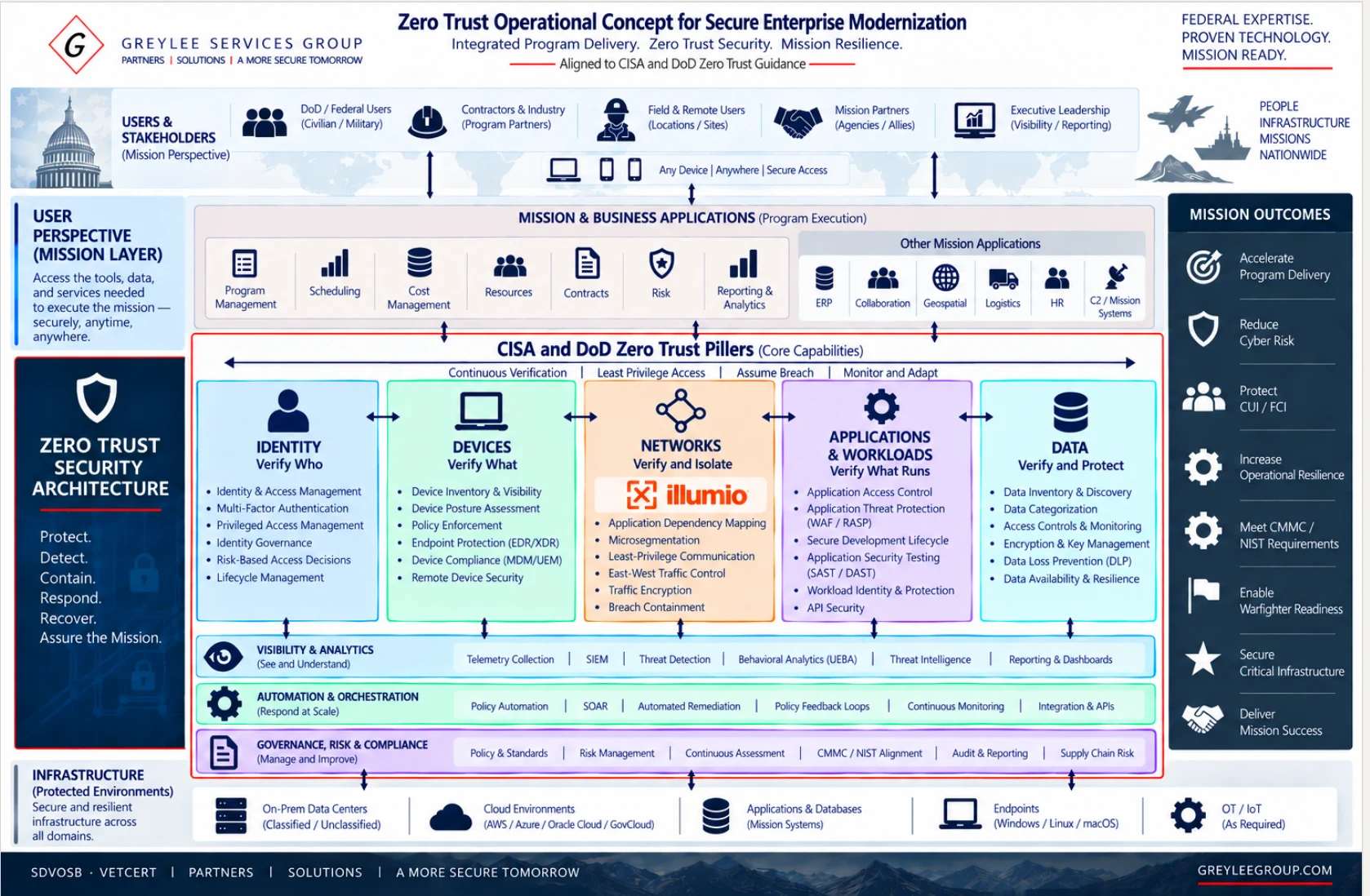
GreyLee Secure Enterprise Modernization operational architecture — users and stakeholders at top, mission and business applications layer, five Zero Trust pillars (Identity, Devices, Networks, Applications and Workloads, Data), three foundations (Visibility and Analytics, Automation and Orchestration, Governance Risk and Compliance), and mission infrastructure at base
What this shows

A single operational view spanning the people who need access, the program work they execute, the Zero Trust security layer that protects it, and the infrastructure it all runs on — the enterprise a CIO or CTO is accountable for securing. The diagram is notional and offered for discussion.

How to read it

Top down. Users and stakeholders reach the environment through an access decision. The mission layer is the work itself. The five Zero Trust pillars sit underneath that work — not in front of it — resting on visibility, automation, and governance, with the infrastructure band as what is being protected.

What it is aligned to

The pillar structure follows CISA’s Zero Trust Maturity Model v2.0 and maps to the seven pillars of the DoD Zero Trust Strategy. The outcomes are program outcomes, not claims about the technology: the architecture supports them; assessment, control implementation, and evidence work deliver them.

The Reference Stack

A Worked Example — Five Products, Chosen to Integrate

Identity & Access
Microsoft Entra
Single sign-on, multifactor authentication, conditional access, device and user context, and identity governance. Set as the reference because most federal and DIB environments already run Microsoft; alternatives are integrated where a customer requires them rather than introduced by default.
“Who are you, on what device, under what conditions?”
Privileged Identity
CyberArk
Privileged access management, secrets and credential management, session isolation, and just-in-time elevation for administrators and service accounts. Standing privilege is the most reliable path from a foothold to a full compromise, and ordinary identity management does not address it.
“And what happens when that identity can change things?”
Segmentation & Containment
Illumio
Application dependency mapping, microsegmentation, least-privilege workload communication, east-west traffic control, and endpoint segmentation. The control that decides what a breach costs: it closes the lateral paths an adversary needs to turn one compromised workload into an enterprise event, and isolates critical and CUI enclaves behind engineered boundaries.
“Once you are in, where can you actually go?”
Detection, Analytics & Response
Elastic
SIEM, centralized logging, threat detection and hunting, investigation, automation, and long-term retention — with endpoint protection delivered through Elastic Defend rather than a sixth manufacturer. Where an agency already runs Defender, CrowdStrike, or SentinelOne, that investment is integrated rather than replaced.
“What is actually happening right now?”
Vulnerability & Exposure
Tenable
Asset discovery, vulnerability management, and risk prioritization across servers, endpoints, network infrastructure, cloud, operational technology, and the long-lived legacy systems that hold much of the federal mission.
“Of everything wrong, what gets fixed first?”
Why the integration is the point

Tenable reports a vulnerable server. Illumio shows which systems can reach it. Elastic shows whether anything suspicious is already touching it. Three findings become one prioritized decision — the move from vulnerability management to exposure management.

Why the stack is deliberately small

Every additional manufacturer adds an integration surface, a support relationship, a renewal, and a training burden. Five can be assessed, deployed, operated, and defended in front of an auditor. Anything beyond enters on mission requirement, not to complete a catalog.

Technology is selected on mission fit and evidence, independent of any manufacturer’s roadmap. The stack above illustrates the architecture; it does not prescribe it.
Federal Alignment

CISA ZTMM v2.0 & DoD Zero Trust

Two federal models govern Zero Trust. CISA’s measures maturity; DoD’s prescribes execution. This architecture is built to answer both.

CISA ZTMM v2.0 DoD Zero Trust Coverage in Reference Architecture
Identity User Microsoft Entra with CyberArk for privileged accounts
Devices Device Elastic Defend endpoint, with Illumio endpoint segmentation
Networks Network & Environment Illumio — data-flow mapping through microsegmentation
Applications & Workloads Application & Workload Illumio with Elastic
Data Data Native platform controls inside engineered protection boundaries
Visibility & Analytics (cross-cutting) Visibility & Analytics (pillar) Elastic with Illumio
Automation & Orchestration (cross-cutting) Automation & Orchestration (pillar) Elastic with Illumio
Governance (cross-cutting) Overarching governance & execution enablers GreyLee — architecture, integration oversight, control evidence, program leadership
Supports multiple pillars Tenable — vulnerability and exposure management

Governance carries no manufacturer by design. It is a discipline, and buying another tool to fill the box does not produce it.

Compliance, Stated Plainly

Where CMMC Stands

Current Status

The acquisition rule has been in force since November 2025 and DFARS 252.204-7021 is appearing in solicitations. Phase 2 third-party certification was suspended in July 2026 pending a reform task force review, and Phases 3 and 4 were frozen with it. The certification mechanism is under review. The underlying obligation under DFARS 252.204-7012 and NIST SP 800-171 is not.

The suspension paused the audit, not the requirement — and GreyLee is ready to answer the call the moment the reformed program lands.

What the technology does and does not do

No stack makes an organization compliant. The stack implements controls; an assessment scores evidence. GreyLee designs the architecture, produces the artefacts, and keeps them true between assessments — CUI scoping, asset inventory, network and data-flow mapping, access-control design, segmentation, SSP development, vulnerability management, logging and monitoring, evidence collection, POA&M remediation, assessment preparation, and continuous monitoring.

Keeping the artefacts true between assessments is the part that fails most often, and it is the part that is a service rather than a purchase.

The Engagement Model

From Strategy to Sustained Operations

GreyLee advises and leads across the full modernization lifecycle — from executive advisory and acquisition through implementation oversight and sustainment governance. The hands-on delivery is performed by teaming partners carrying decades of federal experience.

01
Assess
Executive consulting, current-state and maturity assessments, and compliance gap analysis — including the application dependency mapping and east-west traffic visibility that show where an attacker could move and how large the blast radius would be today. This is the phase that produces the map the segmentation policy is written against.
02
Plan
Strategic roadmaps, modernization and acquisition strategy, enterprise architecture, governance, program planning, funding support, and requirements development written so that performance can actually be measured.
03
Procure
SDVOSB contracting, OEM selection, established distributor relationships (TD SYNNEX, Carahsoft, Vertosoft), licensing, hardware and software procurement, contract vehicles, and proposal support — so the technology in the roadmap can be put on contract without a second competition.
04
Implement
Systems integration, solution deployment and configuration, cloud migration, identity modernization, segmentation and containment policy for critical assets and workloads, AI enablement, testing, and change management. Teaming partners perform the integration and delivery; GreyLee holds design authority, governance, and program leadership across it.
05
Operate & Optimize
Program management, managed-services coordination, governance, compliance monitoring and reporting, lifecycle management, training, and sustainment — then continuous improvement: policy tuning, detection engineering, exposure review, and audit support once the deployment is done.
Core Services — Advisory & Program Leadership (performed by GreyLee)
Executive Advisory Services
CIO / CTO Strategic Consulting
Enterprise Architecture
AI Strategy & Governance
Zero Trust Strategy
Microsegmentation Design
Cyber Resilience Advisory
Identity & Access (ICAM) Strategy
PKI & Certificate Lifecycle
Post-Quantum Readiness
CMMC & Compliance Readiness
Cloud Modernization Strategy
Digital Transformation Strategy
Program & Portfolio Mgmt (PMO)
Acquisition, Sourcing & Licensing
Delivered by teaming partners: Systems integration · Deployment & configuration · Cloud migration · Operations & maintenance · Managed services
Contracting Data

Ready to Contract

CAGE Code

0Q6E5

UEI

UR93NFRB85B5

Certification

SDVOSB VetCert

SAM.gov

Active

NAICS (Primary)

541990

NAICS

541512, 541519

Location

Collingswood, NJ

Resources

Download & Briefing Request

Secure Enterprise Modernization

Operational Architecture Brief · PDF

Request a Briefing

Tell us about your modernization priorities and our team will respond within one business day.

John Vanderpool, Managing Partner

info@greyleegroup.com · (703) 819-8948

Ready to Modernize
With Confidence?

Assume the breach. Keep the mission running. Let GreyLee bring advisory leadership, program discipline, and the right teaming partners to your next modernization challenge.

Contact Our Team